
Discussion: What do the results mean?
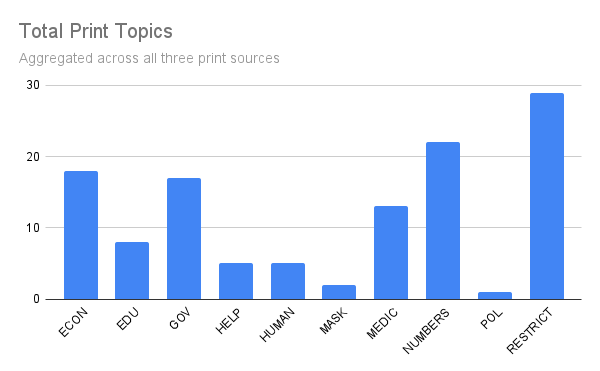
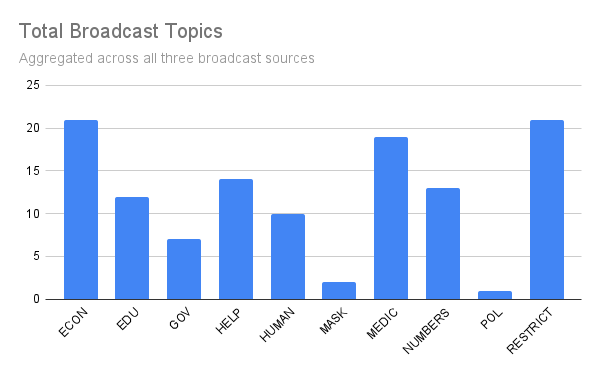
The literature about COVID-19 news coverage describes a national news environment that is highly politicized, polarized and overly focused on controversies. This description, however, is not reflected in the present sample. The near-absence of politics and masks as topics, as well as the unexpectedly low use of “dispute” as a framing device, suggest that these features might have been more prevalent in COVID-19 news coverage at the national level than at the local level.
The finding that local news about the pandemic included less coverage of politics and was infrequently framed in terms of disputes could help explain why people consistently respond in surveys that they trust local news more than national news, including for pandemic-related coverage.
The most common article topics — COVID-19-related restrictions, the number of cases and deaths, the economy and medical responses (largely vaccine-related) — point to the utilitarian nature of much local news coverage. News sources largely covered the basics, such as which events were canceled, how many new deaths were reported each day, whether local businesses were open and when vaccines would become available. Much of this is surely valuable information for community members facing rapidly changing rules, case numbers, risks, vaccine requirements and more.
But these topics also reflect a large amount of fairly simple, “commodity” reporting. Many articles, like those about business closures, event cancellations and daily case counts, appeared to be rewritten from a single source (such as an event announcement or a state COVID-19 tracker).
One must wonder if other, deeper stories — such as disparities in health outcomes or features about the people involved in COVID-19 responses — were passed over in favor of this more basic, utilitarian coverage.
The relatively small number of articles about education was another unexpected finding, given the amount of disruption the public education system experienced due to remote schooling and the wide-ranging impacts on society. Education was only the sixth-most common article topic overall, among both print and broadcast news sources.
This might have been influenced by the time periods studied (as addressed more in the “Limitations” section), but it also lends credence to John Zhu’s lament that local news sources in North Carolina did not adequately cover the pandemic’s impact on their school systems.
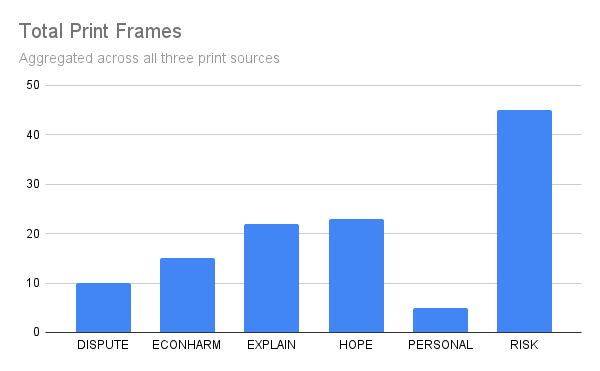
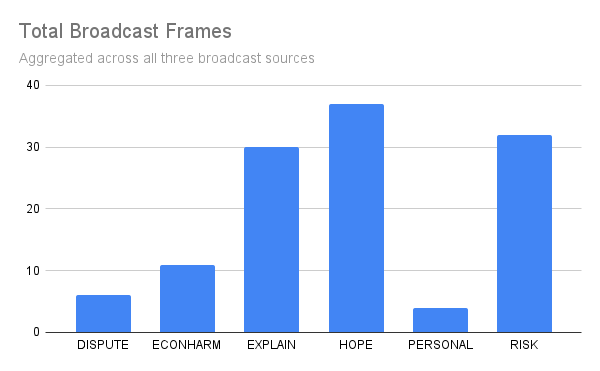
The single most commonly used frame overall was “risk.” This makes sense, given the nature of an emergent pandemic. COVID-19’s early days were extraordinarily risky, an era in which every decision we made was tinged with calculations of the dangers in any given activity.
But the variations between different news sources show that the Risk frame does not have to be the default option for local news coverage in a pandemic. ABC11’s use of Hope and WLOS’ use of Explain as their most common frames demonstrate different approaches to the same topic, whether that be looking for the “silver lining” or trying to provide largely explanatory articles for their audience.
In fact, because of ABC11’s frequent use of the Hope frame, Hope was actually slightly more common than Risk among all broadcast stories. There was greater variation observed among broadcast than print sources (all three of which used Risk most frequently), which might suggest that broadcast news sources approach their coverage and framing decisions in a more flexible, less heterogeneous way than print sources.
The fact that total local COVID-19 coverage declined at most of the news sources over time suggests that those newsrooms used a “flood the zone” strategy in the early stages of the pandemic, assigning all staff to cover every aspect of the emerging crisis that they could. Over time, the number of local articles produced about COVID-19 may have fallen in part because that approach was unsustainable.
In addition, other news priorities emerged during this time. During the fall (study week of Nov. 1), we can assume that COVID-19 was crowded out by other pressing news stories like the 2020 elections, while during the winter (study week of Jan. 3), other news like the Jan. 6 insurrection in the U.S. Capitol could have displaced COVID-19 from the news.
News organizations must constantly make difficult decisions about how to allocate limited resources. As a long-term crisis becomes less novel and more routine, it’s natural to expect news organizations to reallocate some resources to other topics. Audiences and reporters alike grow fatigued. A newsroom can’t stay in “flood the zone” mode forever — eventually, someone must go back to covering the sports, accidents, traffic, weather, school funding squabbles and City Council shenanigans that make up any local news report.
But in a long-term crisis like the COVID-19 pandemic (in its third year at the time of this writing), at times this dynamic created a mismatch between the severity of the pandemic and the amount of local coverage it received. Four of the news organizations (WLOS, the Asheville Citizen-Times, the Southern Pines Pilot and the Charlotte Observer) published far more articles in mid-March 2020 — when there were no reported deaths and only a few dozen COVID-19 cases in North Carolina — than in early January 2021, when there were almost 8,000 daily cases and more than 80 deaths per day in the state (New York Times, n.d.).
The other two news sources, WSOC-TV and ABC11, didn’t see a significant decline in local COVID-19 coverage over the same time period. But their article output also did not increase to reflect the greater local severity of the pandemic in January 2021 vs. March 2020. This suggests news organizations might have placed greater value on the novelty of the pandemic than its impact or proximity, possibly to the detriment of audiences.
This diminution of local coverage over time is particularly apparent in the number of reporter bylines found on articles in the Asheville Citizen-Times and the Charlotte Observer between March 2020 and January 2021. At these two organizations, the sharp decline of distinct bylines suggests a much lower amount of resources were assigned to cover the pandemic in January 2021. Merely looking at the case and death numbers, one would expect the inverse of what actually occurred.
This raises two questions: Were these organizations serving their communities well by assigning fewer resources during a more dangerous phase of the pandemic? And, perhaps more intriguing, was the community well served in mid-March 2020 by the “flood the zone” strategy — or would a more judicious use of resources at the time have been appropriate?
WSOC-TV provides an interesting contrast. During the spring, the news station produced only 40% as many local COVID-19 articles as the Charlotte Observer — 42 v. 107. But across all four periods studied, the difference in total local articles was less than 19%, with WSOC-TV publishing 144 and the Charlotte Observer 179. By the winter — when the pandemic was at its most severe — WSOC actually produced almost twice as many local articles as the Charlotte Observer, 41 compared to 23.
By the fourth week studied — when the pandemic was at its most severe — WSOC actually produced almost twice as many local articles as the Charlotte Observer, 41 v. 23.
The notably higher number of articles per reporter at the Southern Pines Pilot, the smallest of all the news sources studied, points to a heavy workload shared among a small staff. The Southern Pines Pilot produced roughly ⅓ the total number of stories as the Charlotte Observer during the first week studied (March 15, 2020) — but the Pilot did so with just five bylined writers, or only 15% of the 34 local bylines that appeared in the Charlotte Observer that same week. This highlights the large amount of vital work performed by reporters at small community news organizations.
"Local news and COVID-19 in North Carolina" table of contents
- Local news and COVID-19 in North Carolina
- Introduction
- The Problem: COVID-19 and the shrinking local newsroom
- Research questions: What were we trying to figure out?
- Background: What does the existing research say?
- Methodology: How we did the study
- Findings: What we learned
- Discussion: What do the results mean?
- Recommendations: Where do we go from here?
- Limitations: What we couldn’t do
- Areas for further study
- Conclusion
- References, About the author, Special thanks
- Codebook