
Methodology: How we did the study
This project primarily used content analysis of a sample of articles collected from six local news outlets over four distinct time periods in 2020 and 2021. Both quantitative and qualitative methods were used to find, describe, and analyze patterns in COVID-19 coverage.
Content analysis allows researchers to “systematically transform a large amount of text into a highly organised and concise summary of key results.” — Erlingsson & Brysiewicz
The six news sources from different-sized North Carolina media markets were selected to allow for comparisons between different communities within the same state. All three broadcast stations are ABC affiliates owned by different parent companies.
The media markets and news sources include:
Southern Pines
Southern Pines
With a population of just under 16,000 according to the latest U.S. Census estimates, Southern Pines is a small town in Moore County. Located between Fayetteville and Charlotte, Southern Pines is not directly adjacent to any major urban areas. Southern Pines is somewhat unusual in the age of news deserts because it retains a locally owned newspaper. However, Southern Pines does not have a local broadcast station, and relies on TV news from elsewhere that covers Southern Pines episodically.
- The (Southern Pines) Pilot is a locally-owned newspaper that’s taken creative steps to diversify its business by publishing magazines, buying a bookstore, offering new services and investing in its website. With a print circulation of approximately 13,000, the Pilot retains strong local connections and reach. The Pilot was selected because it illustrates the coverage provided by a hyperlocal community newspaper in a small town (Center for Innovation and Sustainability in Local Media, n.d.).
- ABC11 (WTVD) is a broadcast station based in Durham, with a bureau in Fayetteville (its nearest outpost to Southern Pines). ABC11 is owned by ABC, and its broadcast area includes Southern Pines as part of the Raleigh–Durham–Fayetteville television designated media area. ABC11 was selected to examine the extent to which a small town without a TV station of its own received any local broadcast coverage during the COVID-19 pandemic.
Asheville
Asheville
Located in the western North Carolina mountains, Asheville is a small city with a Census-estimated population of approximately 94,000. The metropolitan statistical area surrounding Asheville totals approximately 469,000 residents. Asheville was selected to represent a mid-sized media market in North Carolina. Asheville is ideal for this study because of its relative geographic isolation Despite being smaller than several other mid-sized cities such as Cary, Fayetteville and Concord, Asheville has its own media outlets and doesn’t get lumped in with a larger nearby market such as Charlotte or Raleigh/Durham.
- The Asheville Citizen-Times is a daily regional newspaper owned by Gannett. Like many regional papers, the Citizen-Times has been hit by multiple rounds of consolidation and layoffs, as acknowledged by a Citizen-Times columnist. “So yes, it’s been sad to watch the paper decline, in circulation and staffing. I’d be lying if I told you all the layoffs didn’t hurt like hell…[In 1995], we probably had 75 news employees then, compared to 10 right now” (Boyle, 2020). This provides an opportunity to look at COVID-19 coverage by a midsize regional paper that has been dramatically impacted by cuts to the local news industry.
- WLOS is an ABC affiliate owned by Sinclair Broadcast Group and based in Asheville. WLOS broadcasts to the Greenville–Spartanburg–Asheville market, with a focus on Asheville. This station provides the opportunity to examine pandemic coverage of a midsize television source based in its home city.
Charlotte
Charlotte
With a Census-estimated population of almost 880,000 in the city and a regional population of 2.9 million, Charlotte is the largest media market in the Carolinas.
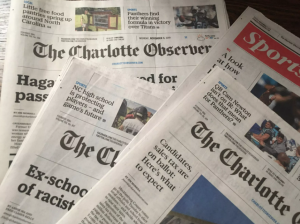
- The Charlotte Observer is the region’s flagship paper. Owned by hedge fund Chatham Asset Management, the Observer has suffered massive staffing cuts (as noted in the literature review) and declining circulation in recent years. Despite this, the Observer retains one of the largest newsrooms in North Carolina. Studying the Observer’s COVID-19 coverage provided information about how a greatly diminished, but still substantial, newspaper approached crisis coverage for its local audience.
- WSOC-TV is an ABC affiliate owned by Cox Media Group, and is frequently the top-rated local Charlotte newscast. WSOC provides the opportunity to examine a leading TV news station’s local pandemic coverage in a large media market.
Time Period
The total study period covered March 1, 2020 to March 1, 2021. This includes the initial outbreak of COVID-19 in the U.S., the institution of stay-at-home orders, mask mandates, remote schooling, vaccine development and early deployment.
Sampling criteria
To select a sample of articles, this study divided the year into equal quarters. Using a random number generator, one week was selected from each quarter. These weeks covered the following time periods: Spring (March 15), Summer (June 3), Fall (Nov. 1) and Winter (Jan. 3). This provided distinct phases of the crisis to analyze, including the beginning and end of the first pandemic year. Relevant news articles published during the selected weeks were retrieved using the search terms “COVID-19”, “coronavirus”, and “pandemic”, from online databases including Newsbank, Proquest, and Google News. A total of 1,482 articles retrieved through these searches were collected, downloaded and screened using standardized exclusion criteria, in order to capture truly local articles.
The following were excluded from the final sample:
- Articles that only tangentially mention COVID-19
- Obituaries
- Letters to the editor
- Outside opinion pieces (Editorials by staff members or editorial boards were included, as some appeared to contain original reporting)
- Sponsored content
- Wire articles republished from the AP and other sources
- Foreign language articles
- Duplicate articles from the same news source
- Running lists of updates (closures, local headlines, etc). All but the most recent version were excluded, in order to filter each incremental update.
A total of 861 articles were removed per the exclusion criteria. The remaining 621 articles were sorted and numbered. Using a random number generator, 10 articles from each of the six sources were selected for each designated week, resulting in a final sample of 240 articles (10 articles per source, per period). This sample represents 38.6% of the total articles in the final sample.
Coding
All articles were then read and coded for both topic and framing using a standardized codebook. Coding was performed based on the predominant topic and framing of an article, not on a present/absent basis. For example, if a story is mainly about the economic damage facing small businesses but also mentions the number of cases and deaths, the article topic would be coded as “economic impact” and not “numbers.” In order to determine the primary focus, more importance was assigned to the headline and first three paragraphs of each article. Each article was also read in full to ensure that the primary focus identified from the headline and first three paragraphs was consistent with the article’s body.
A code is a short label that succinctly describes what the piece of content in question is about (Erlingsson & Brysiewicz, 2017). Topic codes were identified via induction (examining the body of work selected for analysis) and used to describe the primary topic of a story. Topic codes included:
- EDU: Schools and education, including closures and effect on students.
- ECON: Economic impact, including to communities and businesses.
- RESTRICT: Pandemic restrictions and cancellations.
- MEDIC: Medical response, including vaccines
- NUMBERS: COVID-19 cases and deaths.
- POL: Politics and the political impact of the pandemic.
- MASK: Rules, controversy or information about wearing masks.
- HUMAN: A person-centered story; feature or human impact.
- GOV: State or local government response to the pandemic
A second set of codes was used to classify the broader way in which the content and topic of news articles were framed. Previous scholarship using content analysis to examine how the media framed COVID-19 coverage has grouped articles using frames such as “economic consequences,” “misinformation” and “outbreak” (Hubner, 2021). Such frames are typically derived through a combination of induction (examining the specific body of works being studied to derive frames) and consultation of past frames used by researchers examining similar topics. This project followed a similar method to create codes for frames describing how articles present information. Frame codes included:
- RISK: Risk/danger, including deaths and hospitalizations
- POL: Political fighting/controversy
- ECONHARM: Economic damage
- HOPE: Hopeful/positive, a “good news” story
- EXPLAIN: Explanatory/utilitarian/providing information
View the complete codebook here
Understanding the frames used in addition to the specific topics of coverage is important because frames are essential to how audiences interpret the information in news articles. “Frames are interpretive storylines that set a specific train of thought in motion, communicating why an issue might be a problem, who or what might be responsible for it, and what should be done about it…Audiences rely on frames to make sense of and discuss an issue; journalists use frames to craft interesting and appealing news reports; policymakers apply frames to define policy options and reach decisions; and experts employ frames to simplify technical details and make them persuasive” (Nisbet, 2009).
After compiling the codebook, articles were coded manually. A subset of articles — 10% of the full sample — was coded independently by another coder in order to detect any inconsistencies or possible errors in the primary investigator’s use of codes. Similar methods have been used by previous researchers to ensure consistency (Hubner, 2021). The results of this independent coding showed 79% agreement for topic codes (19 out of 24 matched) and 83% agreement on framing codes (20 out of 24 matched). Based on feedback from the independent coder, the codebook was refined and possible overlapping categories were more clearly defined and delineated.
All final codes from the full article sample were then analyzed for frequency, trends, themes and the total share of coverage they represented at each news source. Different news sources and markets were compared to detect similarities and differences in the topics and framing of articles about COVID-19.
The analysis also included an examination of the overall number of articles by each news source and the number of distinct reporter bylines during each study period, in order to see the total volume of local news coverage and make inferences about the resources each news source used over time.
Selected articles were also subject to qualitative analysis, in which the author read these articles in-depth and examined certain topics or themes in greater detail.
Qualitative analysis allows researchers to derive deeper meaning from materials that are “complex, multifaceted and often carry meaning on multiple levels.” — Erlingsson & Brysiewicz
"Local news and COVID-19 in North Carolina" table of contents
- Local news and COVID-19 in North Carolina
- Introduction
- The Problem: COVID-19 and the shrinking local newsroom
- Research questions: What were we trying to figure out?
- Background: What does the existing research say?
- Methodology: How we did the study
- Findings: What we learned
- Discussion: What do the results mean?
- Recommendations: Where do we go from here?
- Limitations: What we couldn’t do
- Areas for further study
- Conclusion
- References, About the author, Special thanks
- Codebook