
Findings: What we learned

The six news sources studied varied in terms of the topics they covered, the frames they used and the amount of coverage they produced. But there were some common themes. Utilitarian coverage of topics such as pandemic-related restrictions and the number of cases and deaths was predominant, while topics such as masks and education were not observed as frequently as expected.
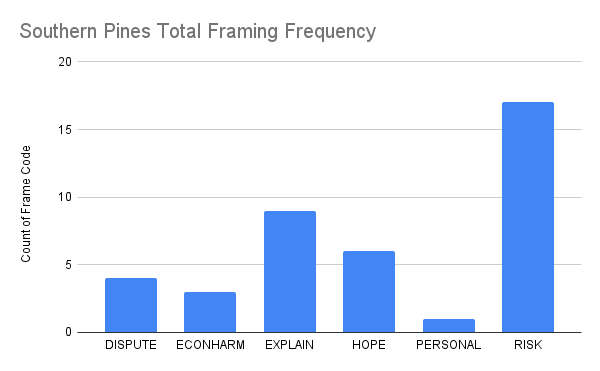
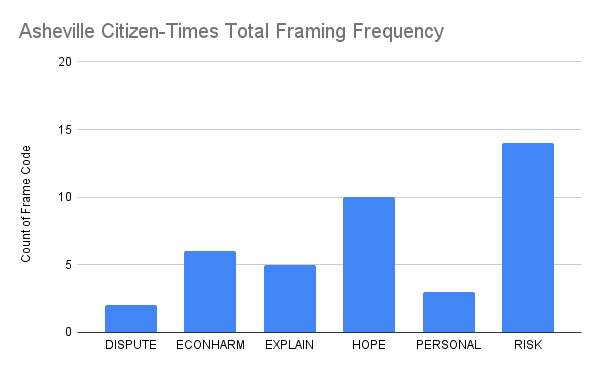
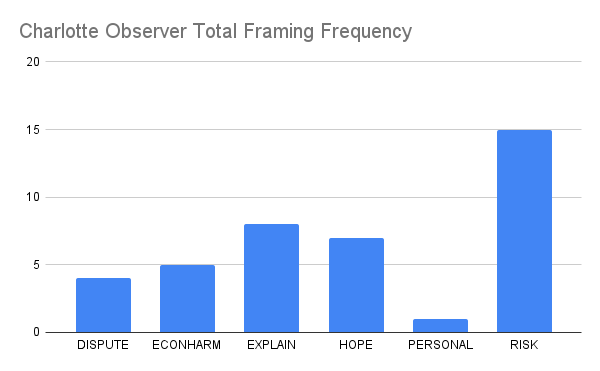
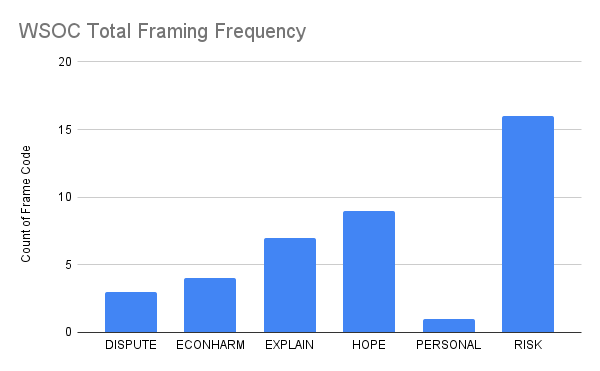
Risk was the most commonly used frame, though some outlets differed and framed more of their coverage around hope or explanatory reporting. And the number of local articles published about COVID-19 generally fell over time, even as the severity of the pandemic increased.
Jump to: Qualitative findings
Quantitative findings
Restrictions, case and death numbers were the most common topics.
In three of the six news sources (The Charlotte Observer, the Asheville Citizen-Times and WLOS), pandemic-related restrictions were the most frequent article topic. At WSOC-TV, restrictions were tied with the number of cases and deaths as the most frequent topic. In the Southern Pines Pilot and ABC11, the number of cases and deaths and the economy were the most common topics, respectively.
In addition to the overall differences in topics between news organizations, several differences were observed over time.
- Medical responses became a more frequent topic in the winter, which coincided with the emergence of vaccines. For example, the Charlotte Observer included five articles on medical response in the winter (half of the total sample) and none in any other period. WSOC-TV had four medical response articles in the winter, compared to just two total articles over the three prior periods. ABC11 had four medical response articles in the winter, compared to four total in the previous three periods.
- The number of articles about restrictions generally peaked in the summer or fall. For example, the Charlotte Observer published three articles on restrictions in the spring, six during the summer, four in the fall and one in the winter. This likely reflects the surge of new restrictions, regulations and event cancellations in the spring, summer and fall of 2020.
- Many of the news organizations published more articles about the economic impact of COVID-19 in the spring and summer, and fewer in the fall and winter. For example, WLOS published three economic impact articles in the spring, two in the summer and only one after that. The Charlotte Observer had four economic impact articles in the spring, zero in the summer, two in the fall and one in the winter. This pattern likely reflects the surge of economic anxiety and layoffs early in the pandemic.
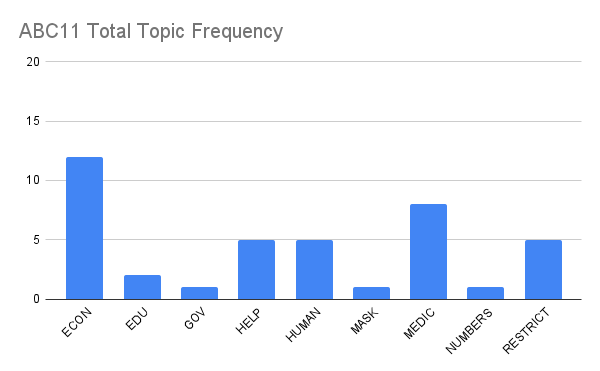


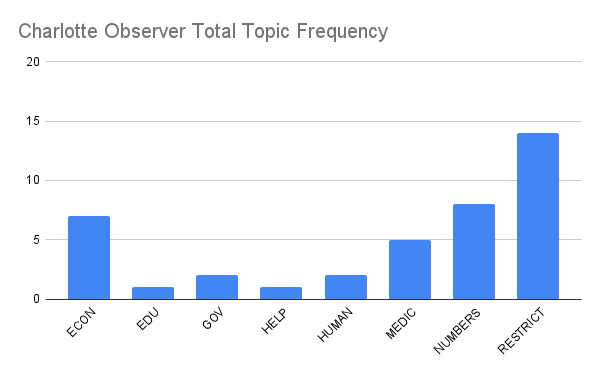
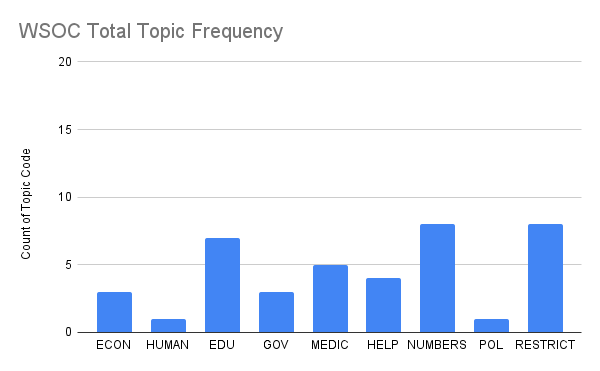
Notably, masks and politics were not frequent topics in the article sample. This was true across all four weeks studied. One or both topics were absent in five of the six news sources studied, and only one source, the Southern Pines Pilot, included articles on both topics. In no source did either topic amount to more than 5% of the articles studied.
This was surprising, given the prevalence of debates about masking in public over the course of the pandemic, the voluminous literature about polarization and politicization of the news, and the coincidence of one study period with the week of the divisive 2020 election. Education, ways to help and the response of local and state governments were also observed less frequently than expected.
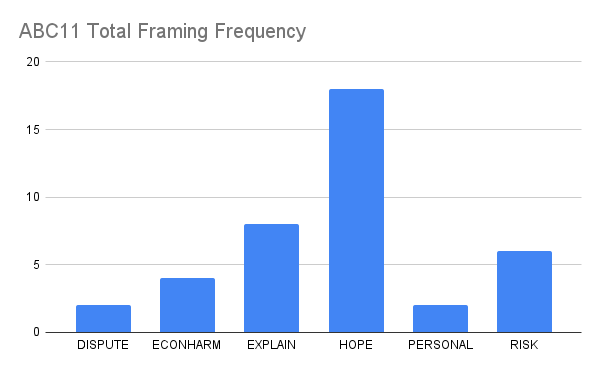
“Risk” was the most common frame, while “dispute” was unexpectedly rare.
“Risk” was the frame most frequently used in four of the six news sources. The exceptions were ABC11 and WLOS. Almost half (45%) of the articles in ABC11 were framed as “hope,” while 20% were framed as “explain.” For WLOS, 35% of stories were framed as “explain” while 32.5% were framed as “hope.” Taken together, that means ABC11 and WLOS each framed roughly ⅔ of their pandemic-related articles as hopeful or explanatory — a much higher share than the other four news sources.
“Dispute” was used infrequently as a frame, occurring in no more than 10% of the articles from any news source studied. Given the previously mentioned literature about the polarization of pandemic news coverage in the national news, this finding was also unexpected, and suggests that the framing of local news coverage might differ from national sources.

No local broadcast news for Southern Pines
Although Southern Pines falls within the broadcast market for ABC11, no truly local articles about Southern Pines were identified in the ABC11 sample. This suggests that residents of Southern Pines received no local coverage at all from one of the major broadcasters serving their area. This finding was not surprising: ABC11’s broadcast market covers multiple counties with dozens of cities and towns, and the station appears to focus its resources on the largest communities in its metro area, such as Raleigh, Durham, Apex and Cary. Southern Pines 60 miles or more from those locations. This finding illustrates the degree to which small communities are unlikely to receive any truly local news from sources based in larger cities.
The number of articles published declined even as the pandemic worsened
The total number of local articles published declined at five of the six news sources over the course of the study (This includes all articles identified during each week, not just the 10 articles sampled for coding).
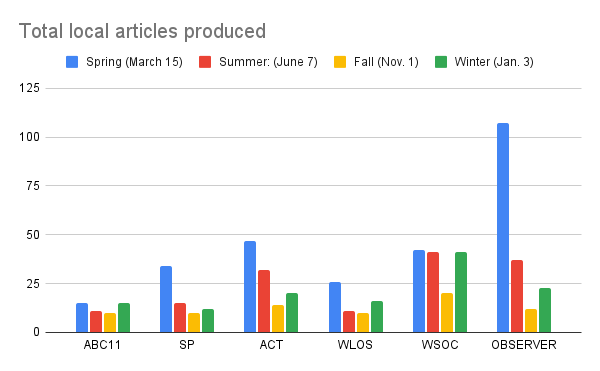
All six news sources published their lowest number of local COVID-19 articles during the fall. The fall week that was chosen (Nov. 1) coincided with the 2020 election, which likely temporarily displaced pandemic-related news. Compared to the spring, the number of local COVID-19-related articles published in the winter fell by:
- 64.7% at the Southern Pines Pilot
- 57.5% at the Asheville Citizen-Times
- 38.5% at WLOS
- and 78.5% at the Charlotte Observer.
- The number of local articles at WSOC-TV declined slightly, while ABC11 was flat.
This decline occurred despite the fact that there were many more cases of COVID-19 and deaths in Jan. 2021 than in March 2020 (New York Times, n.d.). Local coverage fell sharply over time even though the pandemic became objectively much worse.
There were two exceptions. ABC11 produced the same number of local stories about COVID-19 in the spring and winter, though it also produced the fewest total local articles of the six news sources (51, vs. 71 at next-lowest Southern Pines Pilot). WSOC-TV produced nearly the same number of stories (41 or 42) during three of the weeks studied, with the notable exception of election week, when the number of local COVID-19 articles published by WSOC-TV declined by half.
Bylines also declined over time
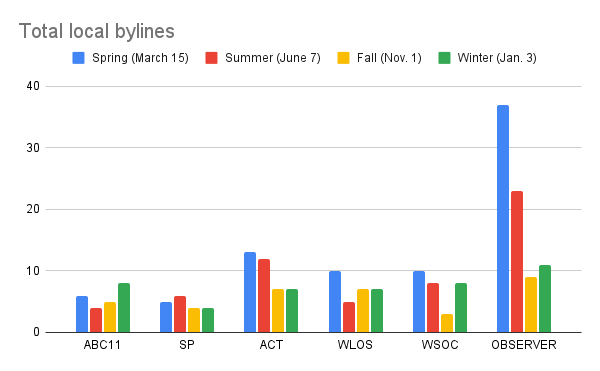
The number of distinct bylines (an approximation of the number of reporters assigned to cover COVID-19) identified during each study week generally fell over time as well. This trend was most pronounced at the Charlotte Observer and the Asheville Citizen-Times.
- At the Charlotte Observer, the number of distinct bylines fell by 70% from the spring to the winter.
- At the Asheville Citizen-Times, distinct bylines fell by 46%.
- At three other news sources, the number of bylines on local COVID-19 articles declined by 20% to 30%.
- ABC11 saw a slight increase in bylines between the spring and winter.
It should be noted, however, that the percentage changes at WSOC-TV, ABC11, the Southern Pines Pilot and WLOS represent only one to three reporters, as they had much smaller numbers of bylines than the Charlotte Observer or the Asheville Citizen-Times to begin with. Notably, all three broadcast stations published a higher proportion of stories without bylines, which might influence this finding.
The smallest paper had the most productive reporters, on a stories-per-byline basis.
The Southern Pines Pilot was a clear outlier among its print peers on one measure: The number of articles produced per byline. Compared to the Asheville Citizen-Times and the Charlotte Observer, each reporter at the Southern Pines Pilot produced many more stories, especially during the spring. The Southern Pines Pilot reporters produced an average of 6.8 articles each, compared to 3.6 at the Asheville Citizen-Times and 2.9 at the Charlotte Observer.
This trend continued in subsequent periods, though it moderated over time. By winter, Southern Pines Pilot reporters were producing an average of 3 articles each, compared to 2.8 at the Asheville Citizen-Times and 2.1 at the Charlotte Observer.
Qualitative findings
Jump back to: Quantitative findings
A more detailed reading of selected articles revealed differences in the way language was used and facts were presented, both between news sources and between articles at the same news source.
Framing varied even for articles about the same topic, by the same news outlet.
A series of three articles published sequentially by WSOC-TV during the fall illustrates how even very similar articles about the same topic can have a different spin. WSOC-TV published daily articles updating case counts and deaths in North Carolina during the pandemic. The first one in this sample, from Nov. 2, was titled “NC reports fewer than 1,500 new COVID-19 cases.” This article was coded as using a “hope” framing, because both the headline and the first paragraph prominently noted the hopeful trend and statistics that cases appeared to be going down. The article noted that the latest numbers represented “the lowest daily increase in cases since Oct. 19.”
The next day, Nov. 3, WSOC-TV published “NC reports highest single-day increase in COVID-19 deaths.” This was also a straightforward story about the number of cases and deaths, but was coded as using the frame “risk” because of the emphasis on the danger posed by the pandemic. The story noted prominently that “67 more people have died from COVID-19, the highest single-day increase since late March when the state reported its first death.”
Two days later, WSOC-TV published “NC reports second-highest daily case increase,” an article that noted twice in the first several paragraphs that North Carolina was seeing “the highest single-day increase [sic] since the start of the coronavirus pandemic” and “the third day in a row that more than 2,000 new cases have been reported.” This article was also coded as using the “risk” frame.
Thus in the space of four days, three seemingly straightforward articles about the number of COVID-19 cases and deaths published by the same news source were framed differently — one emphasizing the positive trend of cases falling, the next two emphasizing the ongoing risk of death and record-high case counts. Audience members could be excused for experiencing whiplash.
News outlets demonstrated different tactics for responding to their audience.
In Asheville, both news sources took an active approach to gathering and responding to audience questions. The Asheville Citizen-Times and WLOS used ongoing mechanisms to solicit questions directly from audience members, which they answered periodically. For the Asheville Citizen-Times, this took the form of “Answer Man,” a column written by reporter John Boyle in response to reader questions. These columns were written with more voice than is typical in a straight news article. For example, in a column answering a reader question about local college enrollment during COVID-19, Boyer wrote: “My answer: Whatever numbers these institutions give me, I’m going to demand a recount. Just seems like the thing to do these days.” He then proceeded to answer the question.
WLOS solicited audience questions for its investigative team to pursue, with this tagline attached to multiple articles: “News 13’s investigative team is working to answer your questions about the coronavirus pandemic and its impacts on Western North Carolina…You can submit your questions to Iteam@wlos.com. News 13’s Jennifer Emert, Lauren Brigman and Karen Zatkulak will work to get an answer for you.” Questions answered for audience members included “What if you can’t wear a mask because of a medical condition?”, “Social distancing markings gone from a WNC superstore?” and “Returning to work after COVID-19, do I need a negative test?” WLOS published the highest percentage of stories coded as using an “explain” framing, which could be due to this emphasis on audience-generated questions.
Other news sources in this study might have employed similar strategies during the pandemic, but such articles were not observed in this sample. ABC11 produced a number of articles that posed questions in the headline or were framed as though they were responding to audience queries. These included articles such as “Mask mouth? Your body may be telling you something,” “How likely is it that you get coronavirus from an asymptomatic person?” and “When will the general public be able to get the vaccine?” However, there was no indication in the articles themselves that they were produced in response to audience questions, and no requests for more audience questions were included, as was the case in the Asheville Citizen-Times and WLOS stories.
Most human-interest articles were about death and risk
Human interest articles were identified in all of the news sources. Many human interest articles reflected death (in the form of news obituaries), the personal experience of severe illness, and themes of hope.
For example, the Asheville Citizen-Times article “Former Sheriff Bobby Medford dies of COVID-19,” described the death of Medford, a colorful and corrupt local sheriff, in a federal prison. The article detailed Medford’s diagnosis, his being placed on a ventilator, and his preexisting conditions, before describing his life and significance to Asheville.
Typical of several stories in the sample describing someone’s brush with near-fatal illness is “Haywood County family told to say goodbye, but loved one battles back from COVID-19.” WLOS tells the story of a local man with Down’s syndrome who was “inseparable” from his family. “Last I seen my son, he was blowing me a kiss and then they cut the iPad off because then they were venting him,” the man’s mother is quoted as saying. The article details the man’s unexpected recovery soon after Christmas, and the tears he shed while on a ventilator that alerted doctors he was still responsive.
Finally, some of the human interest articles in the sample told the stories of those who battled not against COVID-19, but against the pandemic’s other effects. In “This Charlotte trainer pushed through COVID-19,” the Charlotte Observer details how a personal fitness coach persevered through “depressing” to open a new gym. By pivoting to virtual training, she found a way to hang on. The language used in the article, including “thankful,” “grateful,” “trust” and “cheer me on” reflects a generally positive tone despite the pandemic’s hardships.
Human interest stories were not generally used to illustrate other topics, such as the impact on schools, economic harm, government responses or political controversies.
Finding hopeful stories
ABC11 used the “hope” frame more often than any of the other news sources, and the language ABC11 used cast many subjects in a positive light. This resulted in a “silver lining” approach to coverage that highlighted positive aspects of the pandemic. For example, in “Durham woman starts small business, thrives after COVID-19 furlough,” ABC11 notes that the woman’s business “would not exist had it not been for the COVID-19 shutdown.” Using words such as “thrive,” “blossom” and “great year” casts the story as one of empowerment and hope. The article “’Blown away:’ T-shirt fundraiser helps Raleigh small businesses during COVID-19 pandemic” uses language such as “amazing,” “good news,” and businesses “making the most of the opportunity.” The high frequency of such positive language in many ABC11 stories set this station’s coverage apart from the other sources.
Interpersonal disputes were not covered
Although the “dispute” frame was used less often than expected (as noted above), those articles that did use the “dispute” frame were generally about disputes between businesses, political parties or government agencies against one another, not disputes between ordinary people. For example, “Moore County Declines Recommendation to Enforce Mask Mandate” by the Southern Pines Pilot focuses on the disagreements between the county and state officials. Several “dispute” stories were also focused on disputes between businesses and government, such as “After 88 days of being closed, bars wait on” in the Asheville Citizen-Times and “Will Charlotte distilleries have to pay a $14,000 fee?” in the Charlotte Observer.
Given the amount of vitriol and rhetoric around issues such as masks and school closures, it is notable that the “dispute” stories in this sample were about disputes between organizations, not between individuals or between people and the government.
"Local news and COVID-19 in North Carolina" table of contents
- Local news and COVID-19 in North Carolina
- Introduction
- The Problem: COVID-19 and the shrinking local newsroom
- Research questions: What were we trying to figure out?
- Background: What does the existing research say?
- Methodology: How we did the study
- Findings: What we learned
- Discussion: What do the results mean?
- Recommendations: Where do we go from here?
- Limitations: What we couldn’t do
- Areas for further study
- Conclusion
- References, About the author, Special thanks
- Codebook